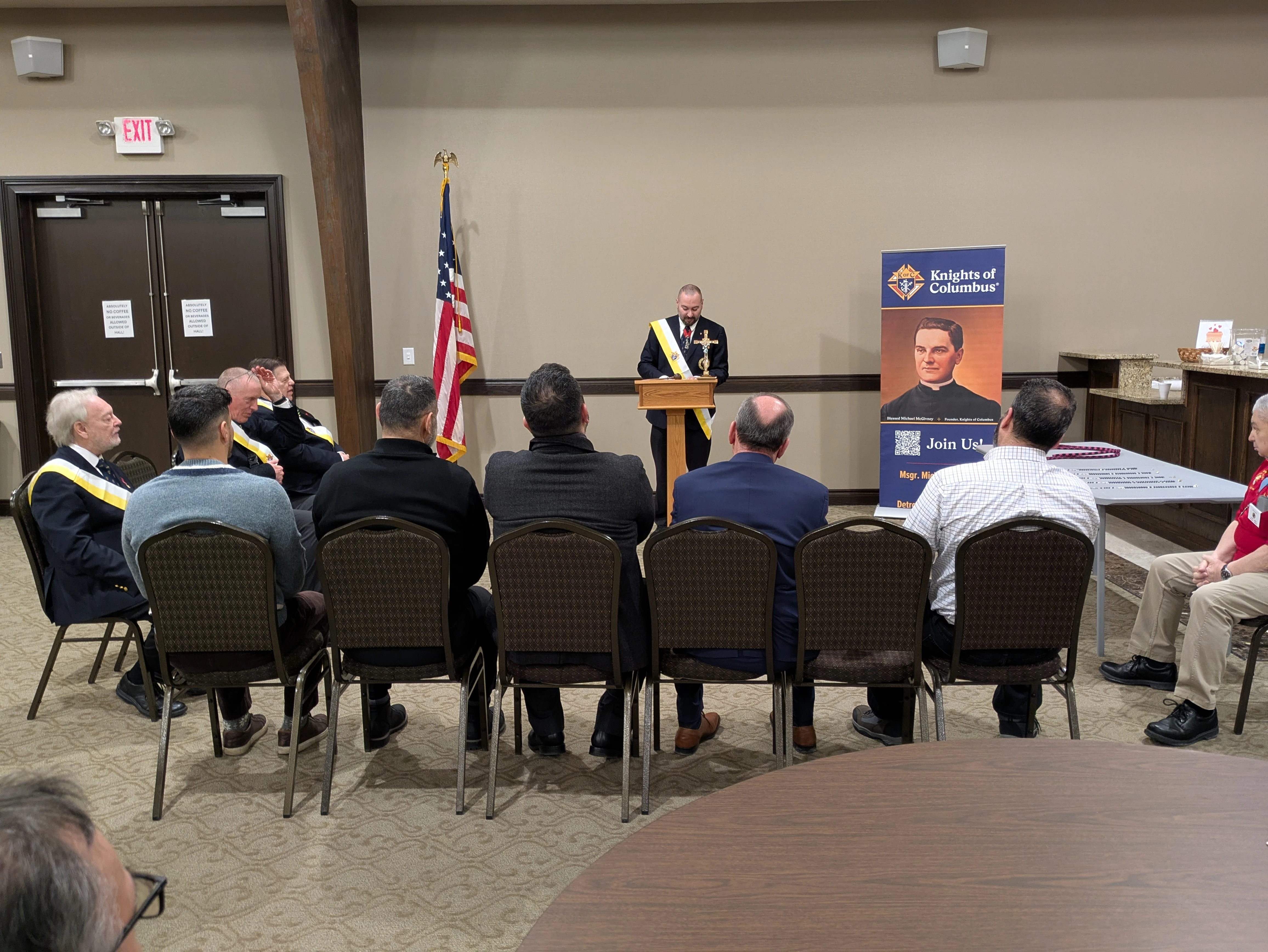
The Story …

  • The March Faith Quest – Knights and Parish Together

    The March Faith Quest – Knights and Parish Together

    So Thomas, called Didymus, said to his fellow disciples, “Let us also go to die with him.” (Gospel for March 22, Jn 11:16)

    Look at the bravery of Thomas! Jesus had just announced his intention to travel to Judea, where he had narrowly escaped getting stoned to death. Given the potential danger ahead, Thomas seems prepared for martyrdom. Later, of course, he and the other disciples would flee as Jesus was arrested, and Thomas would doubt reports of Jesus’ resurrection. As fallible humans, our strength and resolve sometimes collapse into weakness. May we always seek the courage to follow Jesus faithfully, even when the going gets tough.

    Challenge by Supreme Chaplain Archbishop William E. Lori:

    This month, as we continue through Lent, I challenge you to pray the Stations of the Cross each week — in your parish community, with your family or individually — with the intention of receiving the courage to suffer for Christ. A good resource is the Catholic Information Service booklet The Way of the Cross: Traditional and Modern Meditations (kofc.org/shopcis).

    Questions for Reflection:

    • Are you a good disciple of Christ? How can being a Knight of Columbus help prepare you to take up your cross and follow him? Are you willing to suffer for your faith if called upon?

    Feel free to leave comments below.

    The Supreme Chaplain’s Monthly Challenges reproduced here, visit the Knights of Columbus website for original content.

  • Lent: The Courage to Begin Again

    Lent: The Courage to Begin Again

    On February 20, members of Council 8231 and the St. Sharbel Men’s Club led our parish in the Stations of the Cross, beginning the first Friday of Lent in prayer and reflection.

    A collage of men standing at lecterns in a church setting, reading or speaking, with a prominent cross featured in one of the images.

    This moment marked the start of something deeper. Along with Knights around the world, Council 8231 is focusing this Lent on the theme of sacrifice — not simply giving something up, but offering ourselves more fully to God, our families, and our parish.

    Pope Leo XIV reminds us that many people today are searching for something real — a way of life that is authentic, honest, and meaningful. Lent answers that search. It is an invitation to step away from complacency and begin again — to take ownership of our lives, our faith, and our responsibility for one another.

    The Holy Father also notes how rare true repentance has become. Yet when we acknowledge our faults and turn back to God, we make a powerful statement: change is possible. Personal conversion is how renewal begins — in our hearts, our homes, and our Church.

    This season, Knights and parishioners are invited to grow together:
    • Pray the Stations with us on Fridays
    • Reflect weekly on Sunday Scripture and Mass with with Abouna Alfred and Fr. Chris
    • Take part in the February Faith Quest challenge

    An altar setup in a church featuring a crucifix with a purple cloth, gold communion chalices, candles, and religious artwork in the background.

    Lent offers each of us a path to renew a life of freedom — to join an exodus away from stagnation, and to take real ownership and responsibility in the world. Knights can offer an example to all this during this season of lent as we reflect how our lives impact others.

    Let this be a Lent of real sacrifice, real renewal, and real witness.

    Source: USCCB – “Dare to be free, join exodus away from stagnation, pope says on Ash Wednesday

  • The February Faith Quest – Knights and Parish Together

    The February Faith Quest – Knights and Parish Together

    “Blessed are you when they insult you and persecute you and utter every kind of evil against you [falsely] because of me.” (Gospel for Feb. 1, Mt 5:11)

    In the next verse, Jesus continues, “Thus they persecuted the prophets who were before you” (Mt 5:12b). His words imply that his disciples are prophets in their own right, following after the prophets of old. Indeed, as his disciples, we become priests, prophets and kings by virtue of our baptism. In our prophetic role, we are called to speak God’s truth even when it is unpopular in the eyes of the world.

    Challenge by Supreme Chaplain Archbishop William E. Lori:

    This month, I challenge you to learn more about the Church’s teachings on one or two contemporary issues that you are concerned about, so that you can better defend the truth when an opportunity arises. Look to the Catechism of the Catholic Church and booklets from the Order’s Catholic Information Service (kofc.org/cis) as resources.

    Questions for Reflection:

    • Do you shy away from speaking the truth because you fear opposition or repercussions?
    • Does your silence on issues of faith or morals sometimes give others the false impression of agreement?
    • How do you make sure you are being respectful and charitable to others when speaking the truth?

    Feel free to leave comments below.

    The Supreme Chaplain’s Monthly Challenges reproduced here, visit the Knights of Columbus website for original content.

  • From Decline to Discipleship: A Call to Authentic Catholic Witness

    From Decline to Discipleship: A Call to Authentic Catholic Witness

    Engagement and authenticity emerged as the central calls to action at the 2026 Knights of Columbus Detroit Diocesan Meeting. Knights from across the diocese gathered at Sacred Heart Major Seminary to confront a shared reality: declining membership in both the Church and the Knights of Columbus, and the urgent need for renewed, hands-on service rooted in authentic Catholic spirituality. The message was clear—rebuilding the Church will not happen through programs alone, but through lived witness.

    Special guest Archbishop Edward Weisenburger offered both candor and hope as he shared his vision for the reorganization of the Archdiocese of Detroit. He spoke plainly about the aspirations of young seminarians, noting that they do not envision their priesthood as managing institutions in decline. Rather, they desire to shepherd a Church that is alive, growing, and confident in its mission.

    A group of five people, engaged in conversation, inside a historical building with ornate architecture and wooden doors.

    Archbishop Weisenburger reminded those present that, in the Catholic tradition, “the place of worship is consecrated, not just the worship itself.” In any discussion of restructuring, this truth demands reverence for each parish—not merely as a building, but as a living presence within its community. Parishes matter because the people and neighborhoods they serve matter.

    Perhaps the most striking moment of the meeting came when the Archbishop observed, “When a young person walks into a church slightly filled with dedicated elderly, they won’t come back.” These words were difficult to hear—and difficult to say—but they cut to the heart of the challenge before us. A Church without visible generational vitality struggles to inspire those who are seeking a future within it.

    A woman with blonde hair tied in a bun sitting on a wooden pew in a church, viewed from behind.

    Yet the message was not one of despair. Archbishop Weisenburger emphasized that younger generations—Gen Z, Millennials, and others—are actively searching for connection in an increasingly fractured and troubled world. The enduring question, he challenged the Knights to consider, is whether we are truly making disciples. Authentic Catholic social spirituality, lived visibly and consistently, remains the answer.

    This theme was reinforced by Chris Wegener, SEFF Director for the Knights of Columbus, who reflected on COR, the Knights’ spirituality program. Young men, he explained, are not looking for abstraction or formality; they are looking for connection. He supported this with compelling data showing that the fastest-growing segment of the Knights is younger men—a sign of promise, but also responsibility.

    Engagement, however, remains the decisive issue. As Wegener reminded the assembly, “God designed us for community.” The Christ-centered brotherhood of the Knights must serve as a conduit for that community—not only within councils, but outward into parish life and beyond.

    Visibility matters. The Knights must be seen not only inside council halls and church walls, but in the world they are called to serve. We must ask ourselves, “Who is our brother?”—not only within our pews, but among the homeless, the hungry, the unemployed, and every stranger we encounter.

    Often, this mission begins with little ways: a smile, a greeting, an act of kindness offered without expectation. Faith grows when it is exercised. The call before us is simple, yet demanding—to live our faith through action, and in doing so, help rebuild a Church that is vibrant, welcoming, and alive.

  • Welcome New Knights!

    Welcome New Knights!

    Council 8231 proudly welcomed five new Knights on the evening of January 26, marking an important moment in the life of our council and parish. The exemplification ceremony, officiated by our District leaders and Grand Knight Ed O’Brien, served as both a formal welcome and a capstone to Ed’s dedicated recruiting efforts over the past several months.

    A group of men standing in a hall, some applauding, while one man in a suit is shaking hands with another man wearing a red shirt. There are tables and chairs in the background, and the setting appears to be a formal event.

    Through this exemplification, the new members begin their journey as full Third Degree Knights of Columbus, embracing the core principles of Charity, Unity, and Fraternity. These guiding virtues are not merely symbolic, but practical commitments that shape how Knights serve their parish, their families, and their wider communities.

    The evening opened with prayer led by Father Chris, grounding the ceremony in faith and reminding all present that the work of the Knights flows from Christ Himself. This was followed by thoughtful Cor reflections, inviting both new and seasoned Knights to examine the call to faithful service and spiritual growth that defines membership in the Order.

    Throughout the ceremony, Knights were asked to reflect on the enduring mission of the Knights of Columbus: care for those in need, protection of the vulnerable, and a public witness to Christ in everyday life. These commitments are lived out not only through organized charitable works, but through the personal vocations and daily actions of each Knight.

    A group of men standing in a semi-circle, holding papers, during a meeting or ceremony in a community hall. An elderly man sits in the foreground, while another person is visible in the background, wearing a red shirt.

    The Knights of Columbus has long stood as a visible expression of Catholic faith in action. Our traditions of charity, fraternity, and service trace back to our founder, Blessed Father Michael McGivney, whose vision was rooted in compassion for families and communities facing hardship. His legacy continues to inspire Knights today.

    District leaders also reflected on the struggles faced by Catholic migrants in the late 19th and early 20th centuries—families who endured misunderstanding, discrimination, and economic hardship. These historical realities served as a reminder that marginalized communities often face extraordinary challenges, and that our Catholic heritage calls us to respond with courage, solidarity, and mercy. Council 8231 was encouraged to remember these roots and to carry that spirit forward in our own time.

    We warmly welcome our new Knights and look forward to serving alongside them. As Council 8231 continues its mission in service to St. Sharbel, the Church, and the wider community, we are strengthened by their commitment and faith. May God bless our new members and the work we undertake together.

  • The Little Way – St. Thérèse of Lisieux

    The Little Way – St. Thérèse of Lisieux

    Most of us do not walk the halls of power. We do not command vast wealth, shape entire industries, or carry titles that influence millions. For the majority of people, life unfolds quietly—in families, workplaces, parishes, and neighborhoods that rarely attract public attention.

    Yet a quiet life is not an insignificant one. Influence is not measured solely by scale or visibility, but by faithfulness. Each of us possesses levers of real power within our own lives, just as real and consequential as those held by public figures. The most important of these is the power of intention: the decision to act with love, integrity, and responsibility in the circumstances entrusted to us.

    Mother Teresa expressed this truth with characteristic clarity: “Don’t look for big things. Just do small things with great love.” This is not an invitation to think small, but to live deeply. It is a reminder that greatness is formed in consistency, not spectacle—in the ordinary act done well and done with love.

    Scripture reinforces this principle. “Whoever is faithful in very little will also be faithful in much” (Luke 16:10). Faithfulness is not developed in moments of recognition, but in the unnoticed choices of daily life: how we treat our families, how we work, how we respond to frustration, and how we serve when no one is watching.

    The life of St. Thérèse of Lisieux embodies this reality. Born Marie Françoise-Thérèse Martin in 1873, she entered a cloistered Carmelite convent at a young age and died of tuberculosis at just twenty-four. She lived a hidden life, never leaving the convent walls, never addressing crowds, never founding institutions. And yet, she became one of the most influential saints of the modern Church.

    Her spiritual doctrine, known as the “Little Way,” centered on small, everyday acts performed with humility, trust, and love. Thérèse understood that holiness is not reserved for extraordinary missions, but is accessible to anyone willing to offer ordinary duties completely to God. In her words and witness, the smallest act, when done with love, becomes an offering of immense value.

    “Do everything in love” (1 Corinthians 16:14). This command is not abstract; it is profoundly practical. Love transforms routine into vocation and service into witness. Christ himself affirms this in the Gospel: “For I was hungry and you gave me food… I was a stranger and you welcomed me” (Matthew 25:35–40). These are not dramatic gestures. They are concrete responses to real needs, carried out by ordinary people who chose to see Christ in front of them.

    For Knights of Columbus, this truth carries a clear call to action. Knighthood is not confined to meetings, regalia, or organized programs. It is lived daily—in homes, workplaces, parishes, and communities. A Knight’s first field of mission is his own life. Fidelity to family, honesty in work, patience under pressure, generosity toward those in need, and visible commitment to the faith are not secondary acts; they are the core of our witness.

    The Little Way challenges Knights to see every day as an opportunity for service. It asks us to lead quietly, to protect the vulnerable without applause, to serve the Church consistently rather than occasionally, and to bring Christ into places where no institution can reach. A kind word to a struggling coworker, time given to a neighbor, a deliberate act of mercy, or steadfast presence in parish life—these are the works through which Knights shape the culture around them.

    St. Thérèse’s legacy, preserved in The Story of a Soul and recognized by her canonization and designation as a Doctor of the Church, reminds us that enduring impact does not require public recognition. It requires love, offered faithfully.

    For Knights today, the charge is simple but demanding: live your vocation where you are. Do the small things well. Serve with intention. Let your daily actions reflect the King you serve. In doing so, you bear witness that quiet faithfulness, lived consistently, is one of the most powerful forces for renewal in the Church and in the world.

  • Culture of Service, Culture of Charity


    Supreme Knight Patrick Kelly urges that “as Knights, we serve a king, and our king is Christ—and he calls us to protect the most vulnerable.” This conviction stands in stark contrast to a broader cultural landscape that, as Kelly has observed, “has no real answer to this, and that’s because it created this crisis.” The Knights of Columbus propose a different response: “We help young men find mission and meaning in their lives,” he notes, recognizing that men are “hardwired for connection and for purpose.”

    That sense of purpose is most fully realized through works of charity—the concrete and visible means by which the love of Christ is brought to those in need. Service is not incidental to Catholic life; it is formative. It shapes men not merely into volunteers, but into witnesses whose faith is expressed through action.

    Yet the dominant public expression of Christianity in America today is not Catholicism, and in that shift the Church’s historic and pioneering social witness has often been obscured. Figures such as Dorothy Day and Father Daniel Berrigan embodied a faith rooted in radical charity, solidarity with the poor, and a willingness to confront injustice through lived discipleship. Recovering that tradition is not a matter of nostalgia, but of fidelity—to Christ, to the Church, and to a culture of service that remains the Church’s most credible answer to the needs of the world.

    The task before Catholic men, and especially Knights, is therefore not abstract renewal but deliberate action. It requires recommitting time, talent, and presence to works of mercy that place faith in full public view: feeding the hungry, accompanying the vulnerable, and building communities of fraternity rooted in sacrifice rather than convenience. In doing so, the Church’s witness is not merely defended—it is enacted, and Christ is made visible through those who serve in His name.

    Further Reading:
    Dorothy Day and the Catholic Worker Movement
    Father Daniel Berrigan, SJ, and the Catholic peace
    Knights of Columbus Building Mission-Driven Momentum

  • World Children’s Day 2026: A Year Focused on Family, Peace, and Hope

    World Children’s Day 2026: A Year Focused on Family, Peace, and Hope

    Family life is a cornerstone of the Knights of Columbus, and Council 8231 is proud to unite in spirit with the universal Church for the second edition of World Children’s Day, announced by Pope Leo XIV in November 2025. This worldwide observance places children and families at the heart of the Church’s pastoral mission and invites communities everywhere to reflect on how we nurture the youngest among us.

    According to Cardinal Kevin Farrell, Prefect of the Dicastery for Laity, Family, and Life, this special year calls for “particular attention to the world of childhood and the natural environment in which children live and grow.” These words echo deeply with the mission of the Knights of Columbus Family Ministry and with the lived experience of parish life. Children flourish in environments marked by stability, love, and peace—and they suffer when tension and conflict surround them.

    World Children’s Day 2026 will be celebrated at the Vatican in Rome from September 25 through September 27. While most families will not travel to Rome, Council 8231 embraces this moment as an opportunity to join the celebration locally and spiritually. In our homes and within our parish community, we commit ourselves to fostering peace, strengthening family bonds, and creating spaces where children feel secure, valued, and loved.

    Throughout the year of 2026, Council 8231 looks forward to reflecting this spirit in our family-focused activities and parish involvement. By promoting understanding, reconciliation, and charity, we seek to support parents and caregivers and to witness to the dignity of every child.

    Families who are interested in learning more about World Children’s Day or who may wish to express interest in participating in the Vatican celebration can find additional information through the official World Children’s Day website.

    As Knights, parishioners, and families, we are invited to walk together in this shared mission—placing children at the center of our prayers and actions, and renewing our commitment to build communities rooted in faith, peace, and hope for the next generation.

    [https://giornatamondialedeibambini.org/en/join/]

    [https://giornatamondialedeibambini.org/en/contacts/]

  • Pope Leo Shares Gratitude with Catholic Charities USA

    Pope Leo Shares Gratitude with Catholic Charities USA

    Catholic charity organizations across the United States, including here in the Metro Detroit area, work every day to serve families and individuals facing hardship. This mission of charity is one the Knights of Columbus proudly share and support through our commitment to faith in action.

    Poverty is often thought of as a challenge faced only in distant countries, yet millions of Americans live in poverty, many of them children. As parish families and Knights, we are called to recognize these realities and respond with compassion. Sharing our blessings within our parish community also means extending care and support to those beyond it. This outward focus is central to the community ministry of Knights of Columbus Council 8231.

    Recently, Pope Leo offered an apostolic blessing and words of gratitude to Catholic Charities USA, recognizing the vital work carried out by its network across the nation. Founded in 1910, Catholic Charities USA is one of the oldest charitable organizations in the country. It serves as a national membership organization representing 168 independent Catholic Charities agencies, all united in their mission to serve those in need with dignity and hope.

    As we look ahead to 2026, with a special focus on the family and World Children’s Day, our Council hopes to engage the parish more deeply in charitable outreach through Knights of Columbus initiatives. These efforts reflect our shared commitment to supporting families, protecting the vulnerable, and living out the Gospel through service.

    As the new year begins, the Knights of Columbus invite parishioners and community members alike to take part in the many programs and opportunities offered throughout the year. Together, we can celebrate our heritage of service and continue strengthening our local community through faith, unity, and charity.

  • Retiring Daily Reading

    Looking forward to a more robust content calendar in 2006, the daily reading will be retired starting January 10, 2026.

    In lieu of the daily reading look now for the Vatican RSS feed and weekly content from each of our programs.